
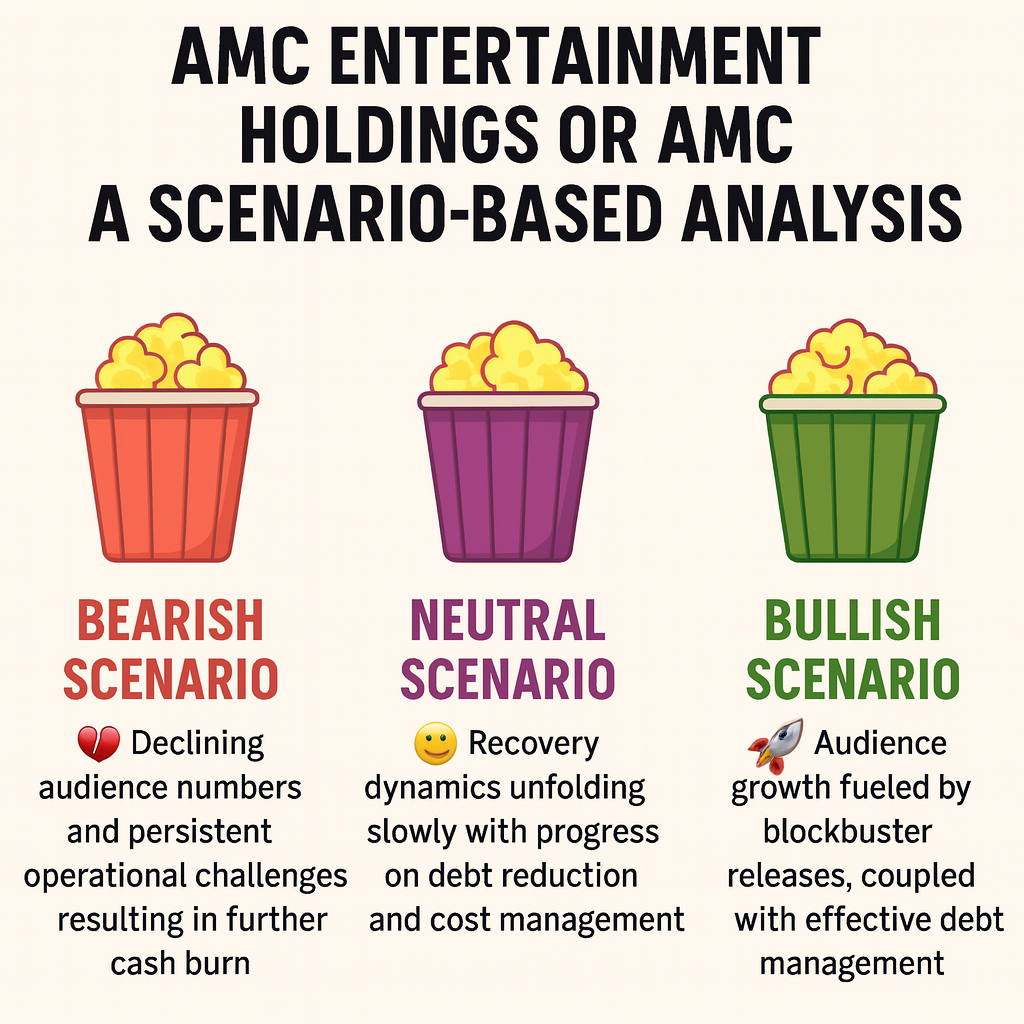
Should I trade AMC Entertainment Holdings or AMC? A Risk-Impact and Scenario-Based Analysis
1. Company Snapshot & Industry Context 🏢🍿
AMC Entertainment Holdings is one of the world’s largest movie theatre chains, operating theatres and screens in the U.S. and internationally. Over the past years it has gone through severe challenges: the pandemic disrupted cinema attendance, streaming services accelerated competition, and debt burdens weighed heavily on its balance sheet.
Industry context: The theatrical exhibition business is undergoing structural pressure — attendance remains below pre-COVID levels in many markets, studios are shortening theatrical windows, and consumers have a growing appetite for streaming/home entertainment. Yet there is a potential rebound in theatre-going if blockbuster content returns and premium formats deliver. For AMC, the question is whether it can capitalise on that while stabilising its finances.
2. Key Financial & Operational Highlights 📊
Here are some recent figures and observations that inform the risk-assessment for AMC:
| Metric | Recent status / note |
|---|---|
| Q1 2025 Revenue | US $862.5 million vs US $951.4 m in Q1 2024. Cloudfront+3AMC Entertainment Holdings, Inc.+3Investing.com+3 |
| Q1 2025 Net Loss | US $-202.1 million (diluted loss per share US $0.47) AMC Entertainment Holdings, Inc. |
| Debt / Cash | As of March 31 2025: Cash & equivalents ~US $378.7 million; Corporate borrowings ~US $4.038 billion. AMC Entertainment Holdings, Inc. |
| Trend in Premium & Loyalty | In Q3 2025, AMC reported admissions revenue per patron (US) ~US $12.25 (a record) and continued growth in premium formats. Investing.com+1 |
| Forward Outlook/Analyst commentary | Some forecasts stress continued losses and heavy dependency on box-office recovery. Simply Wall St+1 |
Interpretation: While AMC still has scale and brand, the financials remain challenging — losses are large, debt heavy, and the recovery is uncertain. The emphasis on premium formats and loyalty programs is a positive operational signal, but execution risk and macro risk remain large.
3. Risk & Impact Analysis ⚠️
Now we explore major risks facing AMC, the possible impact if they materialise, and the company’s relative preparedness.
a) Box Office / Attendance Recovery Risk
Risk: The theatre-going audience may not return to pre-pandemic levels, or may do so slowly. Studios may continue to shorten theatrical release windows or release more content direct-to-streaming.
Impact: Lower admissions, weaker revenue, underutilised theatres, margin contraction.
Status: AMC experienced Q1 2025 domestic box office weaker than expected; the company labeled the January-March box-office as “lowest since 1996” (excluding pandemic) and flagged this as “highly problematic if it continues”. MarketWatch+1
Likelihood: Medium to high. Attendance recovery remains volatile.
Preparedness: Moderate. AMC is doubling down on premium formats, loyalty, and higher revenue per patron — which could offset lower volumes partially.
b) Debt & Liquidity Risk
Risk: With large borrowings and cash outflows, failure to generate positive cash flow could lead to refinancing risk, dilution, or restructuring.
Impact: Financial distress, dilution of equity, limited growth investment.
Status: AMC has recently taken steps: debt deals, governance changes, monetisation of premium offerings. The Wall Street Journal+1
Likelihood: High. The debt burden remains heavy and free cash flow is negative (e.g., Q1 2025 free cash flow ~US $-417 million) per filings. AMC Entertainment Holdings, Inc.
Preparedness: Moderate to low – the actions show intention but the underlying business recovery is still uncertain.
c) Content/Studio/Industry Risk
Risk: The availability of blockbuster film releases (which drive theatre attendance) is uncertain. Studios consolidations, release strategy changes, or supply chain/labour issues may reduce the quality or quantity of theatrical content.
Impact: Weaker foot traffic, fewer premium events, reduced ancillary revenue (F&B, premium formats).
Status: AMC management emphasised upcoming “huge” movie release pipeline (e.g., Avatar sequel, major brand films) as a tailwind. AMC Entertainment Holdings, Inc.+1
Likelihood: Medium. While the pipeline looks strong, risk of delay or poor performance remains.
Preparedness: Moderate. AMC’s investment in premium formats and live-event experiences (concerts + live screenings) position them to capture non-traditional theatre content.
d) Competition & Shift to Streaming Risk
Risk: Streaming services, home entertainment, alternative content formats continue to grow, reducing the share of time and wallet consumers allocate to cinema.
Impact: Reduced attendance, pressure to discount ticket prices or offer promotions, margin erosion.
Status: This is a secular pressure; AMC acknowledges the shift and is pivoting to premium experiences to differentiate. Seeking Alpha+1
Likelihood: High. The streaming substitution trend has strong momentum.
Preparedness: Moderate. AMC’s premium large‐format screens and loyalty programs provide defensive positioning, but may not fully offset the trend.
e) Macro / Cost / Operational Risk
Risk: Rising costs (labour, energy, film exhibition fees), inflation, recession, supply chain disruptions, and changing consumer spending behaviour could all hurt margins.
Impact: Margin squeeze, fewer discretionary theatre visits, slower growth.
Status: Q1 showed higher operating loss and lower revenue; operational leverage remains a challenge. AMC Entertainment Holdings, Inc.
Likelihood: Medium. Many macro risks are active globally.
Preparedness: Moderate. AMC is reducing screens, optimising operations, emphasising higher-margin revenue per patron, but scale changes take time.
4. Scenario-Based Outlook for 2025 🔮
Let’s define three plausible scenarios for AMC in 2025, assign illustrative probabilities and expected outcomes.
| Scenario | Description | Probability* | Key Outcomes | Implications for Stakeholders |
|---|---|---|---|---|
| Optimistic Case | A strong rebound in theatre attendance, robust release pipeline of blockbuster films (including premium live events), cost discipline hits, debt refinancing holds, premium formats win. | ~ 25% | Revenue growth high (e.g., +15-20%), narrowing losses or modest profit, free cash flow turns positive, stock recovers significantly. | Equity gains; creditors regain confidence; AMC becomes turnaround story; streaming-competition risk moderated. |
| Base Case | Moderate recovery: attendance improves but remains below pre-pandemic; premium formats help; cost controls moderate loss; debt servicing manageable. | ~ 50% | Revenue growth modest (e.g., +5-10%), losses narrow but remain; free cash flow still negative but improving; equity remains speculative but viable. | Business survives with caution; limited upside; stakeholders remain watchful. |
| Downside Case | Attendance remains weak or declines; blockbuster release pipeline under-delivers; streaming competition intensifies; cost and debt burden remain heavy; liquidity stress. | ~ 25% | Revenue flat or decline; losses widen; potential asset sales or restructuring; equity severely impaired. | High risk for equity; creditors may push harder; the company becomes distressed or worse. |
*Probabilities are illustrative and for planning purposes only; not financial advice.
5. Strategic Levers & Growth Opportunities 🚀
What can AMC do to tilt the outcome toward the optimistic scenario? Here are strategic levers and opportunities:
-
Premium format expansion: AMC’s focus on IMAX, large-format screens, enhanced food & beverage, loyalty members & subscriptions (AMC Stubs) can drive higher revenue per patron and differentiate theatre visits. For example: Q3 2025 noted admissions revenue per patron US $12.25 (a record). Investing.com
-
Live events / alternative content: Beyond typical film releases, AMC is developing capability to host concerts, live broadcasts, esports, theatre productions in its large screens, providing a new revenue stream and reducing dependence on film release timing. Investing.com+1
-
Cost/operational optimisation: Streamlining theatre footprint, improving operations, renegotiating leases, optimising labour and energy costs, closing underperforming locations will help reduce cost base and improve margin resilience.
-
Debt refinancing / capital structure improvement: Stronger liquidity, lower debt maturities, fewer share issuances reduce overhang and allow for smoother execution of turnaround strategy. AMC recent deals (US $223 m new financing, debt conversions) are positive. The Wall Street Journal
-
Global expansion / diversification: Leveraging international markets, expanding in regions with growth potential or underserved theatre markets may provide longer-term growth beyond US domestic. Management commentary hints toward Europe/UK expansion. Investopedia
-
Enhanced loyalty & subscriptions: Building recurring revenue via memberships (AMC Stubs) and cross-selling premium food/beverage—helped AMC increase revenue per patron even when attendance was down.
-
Partnerships with Studios & Content Creators: Securing exclusive or first-run deals, earlier access to high-profile releases, premium windows for live content, may help drive traffic and pricing power.
If these strategic levers are executed well and macro tailwinds align, AMC could tip into the optimistic scenario. If execution falters or headwinds prevail, the risk leans toward the base or downside case.
6. Monitoring & Trigger List 🕵️
To track AMC’s progress and trigger shifts between scenarios, here are key indicators to watch:
-
Attendance trends (domestic and international) vs pre-pandemic benchmarks and vs prior year.
-
Revenue per patron (ticket + food & beverage) – is this growing?
-
Premium format share of revenue & contribution margin from premium screens.
-
Free cash flow and operating cash flow – is it turning less negative or positive?
-
Debt maturities, refinancing announcements, share issuances – is equity dilution increasing?
-
Studio release pipeline quality and timing – blockbuster titles, live events, alternative content.
-
Competitive activity: streaming platforms, other theatre chains, home entertainment consumption trends.
-
Cost base changes: theatre count, screens, occupancy rates, lease / rental expenses, labour cost inflation.
-
Global expansion/strategic initiatives – e.g., number of new screens, international growth metrics.
-
Capital structure improvements: new financing deals, debt‐for‐equity exchanges, governance changes.
-
Stock market sentiment / analyst upgrades or downgrades (e.g., recent upgrade by Wedbush citing premium screens and improved debt situation) Investopedia
Positive signals across many of these would increase odds of the optimistic scenario; negative signals increase risk of the downside.
7. Summary & Outlook 🧾
In summary:
-
AMC is in a challenging yet potentially turning point moment. The company has the scale, brand and some operational positives (premium formats, loyalty growth, global footprint) on its side.
-
However, substantial headwinds remain: attendance uncertainty, heavy debt and cash-flow deficits, streaming competition, and exposure to macro cycles of discretionary spending.
-
The most likely outcome (base scenario) is moderate improvement — better than the darkest days of the pandemic era, but still not a robust return to pre-pandemic profitability or free cash flow.
-
If everything aligns (premium content, attendance rebound, cost control, capital structure improvement) then the optimistic outcome is possible — AMC becomes a turnaround story with meaningful equity upside.
-
Conversely, if attendance remains weak, content pipeline falters or costs stay elevated, the downside remains real: deeper losses, possible restructuring, and severe equity risk.
My 2025 Outlook: If I were to pick a working forecast, I’d lean towards the base case. I expect AMC to show improvement in attendance and revenue per patron, narrow its losses somewhat, and perhaps approach break-even on a cash-flow basis. But I would not expect full profitability or explosive equity upside unless several favourable conditions converge. For equity investors, the upside is meaningful but speculative; the downside is steep. For creditors and long-term stakeholders, stabilisation is plausible but not guaranteed.
8. Final Thoughts 🎇
-
If you believe that theatre going will rebound strongly, blockbuster content will return and consumers will pay a premium for experience, then AMC could be a high-risk/high-reward play.
-
If you are cautious about consumer behaviour post-pandemic, sceptical about theatrical release models, or concerned about heavy debt and competition from streaming, then AMC remains a risk-laden equity.
-
For someone interested in the broader entertainment sector (including from Thailand or Asia context), the trends at AMC offer a micro-cosm of how theatrical exhibition globally is evolving. The pivot to premium experiences, live events and loyalty programmes are strategies that apply globally.
-
As always: diversify. Given AMC’s volatility and risk profile, it may form a small, speculative portion of a portfolio rather than a foundation stake.